



Search
- Page Path
- HOME > Search
Case Report
- Acute Obstructive Pyelonephritis With Bilateral Hutch Diverticula in an Adult: A Case Report
- Kyu Hyoung Cho, Gilho Lee, Youn Soo Jeon
- Urogenit Tract Infect 2026;21(2):136-139. Published online August 31, 2026
- DOI: https://doi.org/10.14777/uti.2652024.012
-
 Abstract
 PDF
PDF PubReader
 ePub
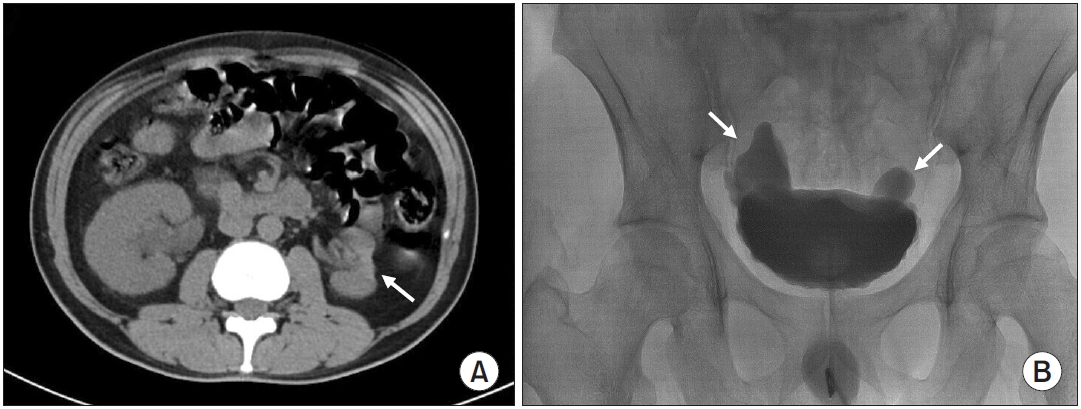
ePub - Hutch diverticula are congenital bladder diverticula arising at the ureterovesical junction, typically associated with pediatric vesicoureteral reflux (VUR). Acute obstructive pyelonephritis occurring in an adult with bilateral Hutch diverticula is rare. The presence of a periureteral diverticulum may complicate ureteral stent placement and interpretation of postprocedural imaging findings. We report a 39-year-old man who was diagnosed with bilateral Hutch diverticula while being treated for acute obstructive pyelonephritis caused by a 4-mm proximal right ureteral stone. Following urgent right ureteral stenting and antimicrobial therapy, the patient's symptoms resolved, and he was discharged after 10 days of hospitalization. A subsequent voiding cystourethrogram confirmed bilateral Hutch diverticula but did not demonstrate definitive VUR. The imaging and cystoscopic findings clearly demonstrated the anatomical relationship between the right ureteral orifice and the adjacent right diverticulum. In addition, the distal coil of the double-J stent was lodged within the diverticulum, mimicking upward migration of the stent on kidney-ureter-bladder radiography. This case highlights a technical and radiologic pitfall of ureteral stenting in a patient with bilateral Hutch diverticula and emphasizes the importance of careful anatomical assessment during endourological intervention.
- 240 View
- 8 Download

Original Article
- An Eight-Year Experience of Transvaginal Urethral Diverticulectomy: A Single-Center Study
- Hyeon Woo Kim, Jeong Zoo Lee, Yangkyu Park, Dong Gil Shin
- Urogenit Tract Infect 2022;17(3):89-95. Published online December 31, 2022
- DOI: https://doi.org/10.14777/uti.2022.17.3.89
-
Abstract
PDFPubReaderePub
- Purpose: This study aimed to analyze and report the surgical outcomes in female patients with urethral diverticulum (UD) over an eight-year period at a single center.
Materials and Methods: Data of 49 UD females who underwent transvaginal urethral diverticulectomy between October 2011 and December 2019 were collected. The characterization of UD was reviewed using pelvic imaging studies. The pre- and post-operative symptoms, post-operative complications, and pathological findings were analyzed by reviewing the medical records.
Results: The most frequent pre-operative symptom was dysuria (n=18), followed by incontinence (n=14), and these symptoms persisted until 3 months post-operatively in one and six patients, respectively. Pre-operative incontinence was cured in eight patients; however, de novo stress urinary incontinence occurred in five patients within a month after surgery. Submucosal macroplastique injection was administered to these patients; of whom, one was cured and three showed an improvement. Recurrent UD was found in seven patients at a mean of 14.14±17.21 months post-operatively, and a repeat diverticulectomy was performed in six of them; of these, one recurred again and was cured after the third diverticulectomy. Urethral strictures were observed in two patients within a month after the operation but improved after urethral dilatation. Bleeding and surgical site infections were observed in one and two patients, respectively, but were successfully managed conservatively. According to the pathological report, only one was diagnosed with urethral adenocarcinoma.
Conclusions: Transvaginal urethral diverticulectomy can effectively manage UD, and its post-operative complications can be successfully managed by a proper treatment.
- 6,734 View
- 13 Download
 First
First Prev
Prev


