



Search
- Page Path
- HOME > Search
Case Reports
- Bilateral Xanthogranulomatous Pyelonephritis With Extensive Abscess Associated With Neurogenic Bladder: A Case Report
- Sin Woo Lee, Hee Seung Choi
- Urogenit Tract Infect 2026;21(1):40-43. Published online April 30, 2026
- DOI: https://doi.org/10.14777/uti.2550026013
-
 Abstract
 PDF
PDF PubReader
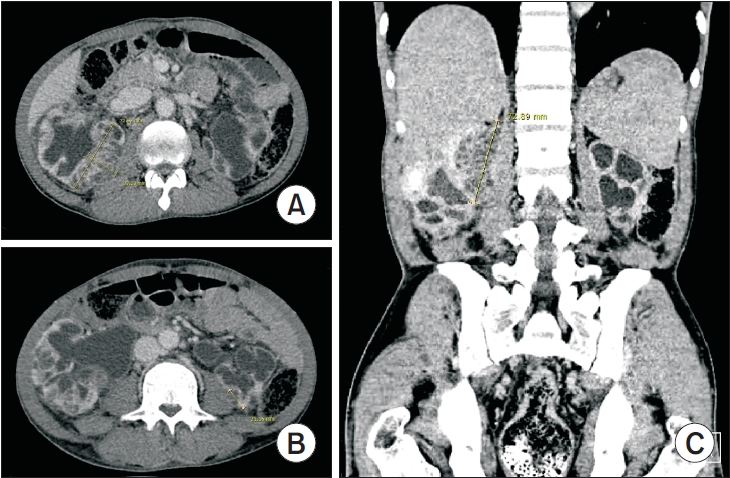
 - Xanthogranulomatous pyelonephritis (XGP) is a rare and severe form of chronic pyelonephritis. We report a case of bilateral XGP complicated by extensive abscess formation. A 47-year-old man presented with fatigue and generalized weakness. Laboratory evaluation revealed leukocytosis and elevated serum creatinine levels. Urinalysis demonstrated pyuria and bacteriuria. Computed tomography (CT) revealed bilaterally enlarged kidneys with multifocal renal parenchymal and perirenal abscesses. The CT scan also demonstrated severe bilateral hydronephroureter and diffuse bladder wall thickening, with a radiologic impression of severe pyelonephritis with abscess formation and neurogenic bladder. The patient was admitted and treated with intravenous antibiotics and percutaneous nephrostomy tube placement. However, no clinical improvement was observed with conservative management. The patient subsequently underwent right open radical nephrectomy. Histopathological examination confirmed the diagnosis of XGP with extensive abscess formation. The patient experienced no further complications or recurrence after surgery. This case suggests that chronic untreated neurogenic bladder may contribute to the development of severe chronic pyelonephritis such as XGP.
- 1,172 View
- 19 Download

- Klebsiella pneumoniae-Induced Emphysematous Prostatic Abscess Accompanied by a Spinal Cord Infarction: Case Report
- Seong Uk Jeh, Min Sung Choi, Chang Seok Kang, Dae Hyun Kim, Jae Hwi Choi, See Min Choi, Sung Chul Kam, Jeong Seok Hwa, Jae Seog Hyun
- Urogenit Tract Infect 2024;19(3):104-108. Published online December 31, 2024
- DOI: https://doi.org/10.14777/uti.2448024012
-
Abstract
PDFPubReader
 ePub
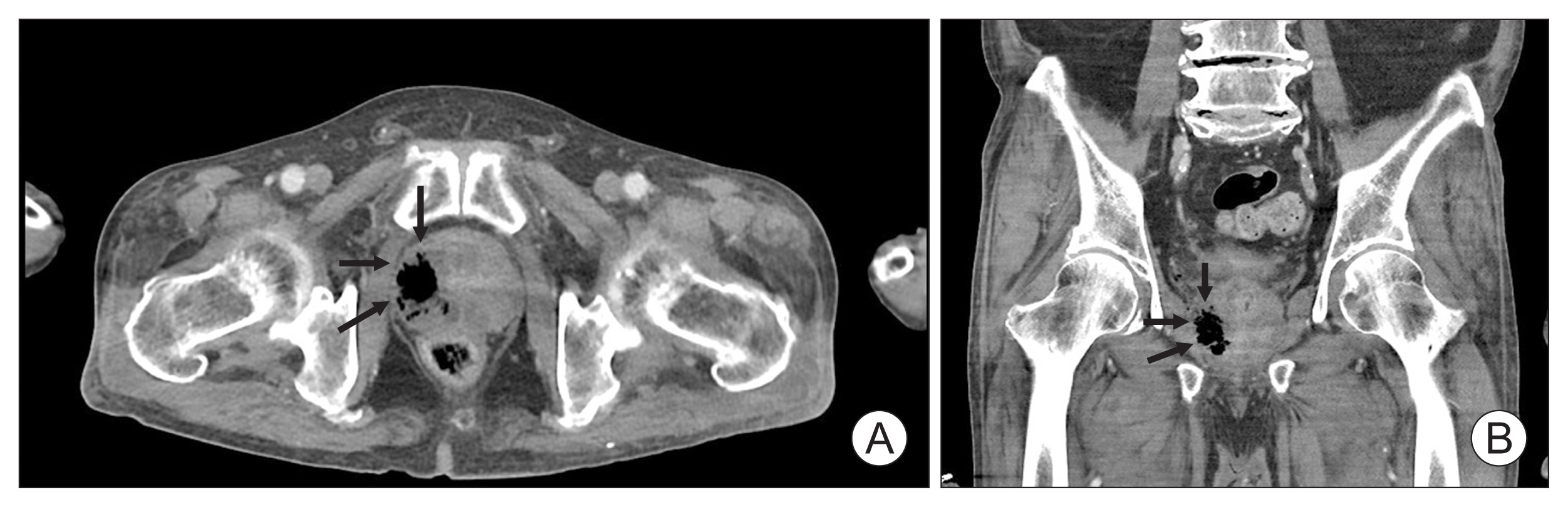
ePub - Various strains can be found in emphysematous prostatic abscesses (EPAs), but the most frequent causative organism is Klebsiella pneumoniae . Hypervirulent K. pneumoniae can disseminate to distant sites by forming a muco-polysaccharide network outside the capsule. Here, we present the first case of K. pneumoniae in an EPA accompanied by a spinal cord infarction. A 65-year-old man was referred to our hospital due to sudden-onset paraplegia after a 5-day history of fever, myalgia, and voiding difficulty. Abdominal computed tomography revealed a collection of air pockets in the prostate, and diffusion-weighted magnetic resonance imaging showed high signal intensity in the thoracic spinal cord. The patient was initially treated with antibiotics and surgical drainage. On the third hospital day, therapeutic heparin was added after discussion with a neurologist. The patient had no inflammatory symptoms, experienced some improvement in paraplegia, and was discharged on the 14th hospital day. This study adhered to the case report guidelines.
- 4,847 View
- 28 Download
 First
First Prev
Prev


