


Search
- Page Path
- HOME > Search
Original Article
- Efficacy of D-Mannose in the Management of Urinary Tract Infections: From Acute Treatment to Long-term Prophylaxis — A Systematic Review and Meta-analysis
- Jae Yong Jeong, Young Joon Moon, Dong Hyuk Kang, Hae Do Jung, Lawrence Kim, Joo Yong Lee
- Urogenit Tract Infect 2026;21(2):111-124. Published online August 31, 2026
- DOI: https://doi.org/10.14777/uti.2652010.005
-
 Abstract
 PDF
PDF Supplementary Material
 PubReader
 ePub
ePub - Purpose
To evaluate the efficacy of D-mannose for preventing recurrent urinary tract infections (UTIs), including in kidney transplant recipients, and to clarify discrepancies between early openlabel and placebo-controlled trials. Materials and Methods: PubMed, Embase, CENTRAL (Cochrane Central Register of Controlled Trials), and Web of Science were searched from inception to February 2026. Randomized controlled trials (RCTs) comparing D-mannose with placebo, no treatment, antibiotics, or active controls were included. Risk of bias (RoB) was assessed using RoB 2, and certainty of evidence using GRADE (Grading of Recommendations, Assessment, Development, and Evaluations).
Results
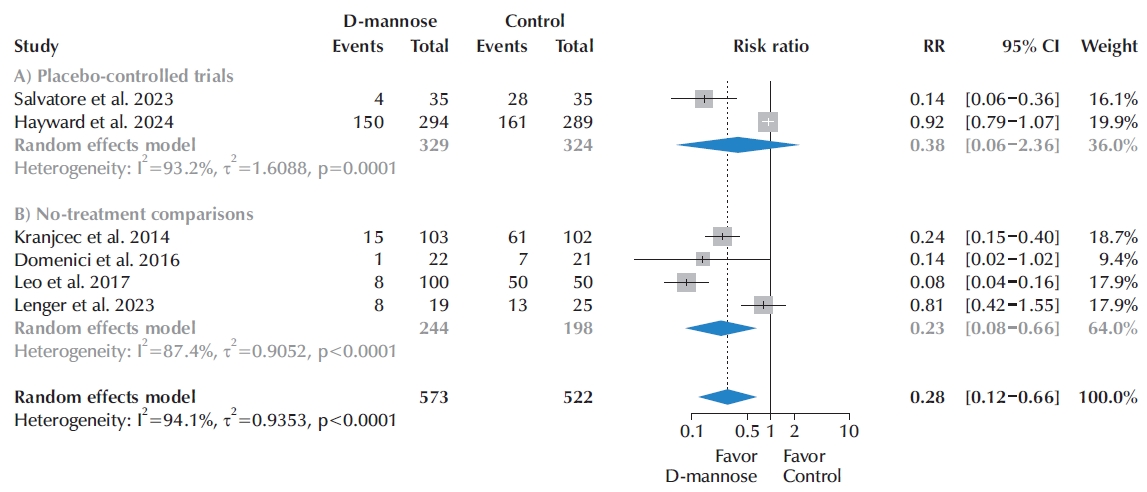
Eleven RCT reports involving 1,724 participants were included; 10 independent study populations involving 1,631 participants contributed to quantitative analyses. In placebo-controlled trials, D-mannose did not significantly reduce UTI recurrence or persistence versus placebo (risk ratio [RR], 0.38; 95% confidence interval [CI], 0.06–2.36). No-treatment comparisons showed reduced recurrence (RR, 0.23; 95% CI, 0.08–0.66), but were more vulnerable to expectation, performance, and detection biases. The exploratory combined estimate favored D-mannose (RR, 0.28; 95% CI, 0.12–0.66), but certainty was very low. Antibiotic comparisons were inconclusive (RR, 0.43; 95% CI, 0.18–1.05), whereas proanthocyanidins active-control comparisons favored D-mannose-containing regimens (RR, 0.57; 95% CI, 0.40–0.82), including data from kidney transplant recipients.
Conclusions
Current placebo-controlled evidence does not establish superiority of D-mannose over placebo. Apparent benefits were mainly driven by no-treatment comparisons with very low certainty. D-mannose remains biologically plausible but clinically uncertain; adequately powered, double-blind, placebo-controlled trials are needed before firm recommendations can be made.
- 1,630 View
- 18 Download

Case Report
- Hemangioma Mistaken for Renal Cell Carcinoma in a Patient With End-Stage Renal Disease: A Case Report
- Hyung-Lae Lee, Dong-Gi Lee, Jeong Woo Lee, Jeonghyouk Choi
- Urogenit Tract Infect 2025;20(1):48-51. Published online April 30, 2025
- DOI: https://doi.org/10.14777/uti.2550008004
-
Abstract
PDFPubReaderePub
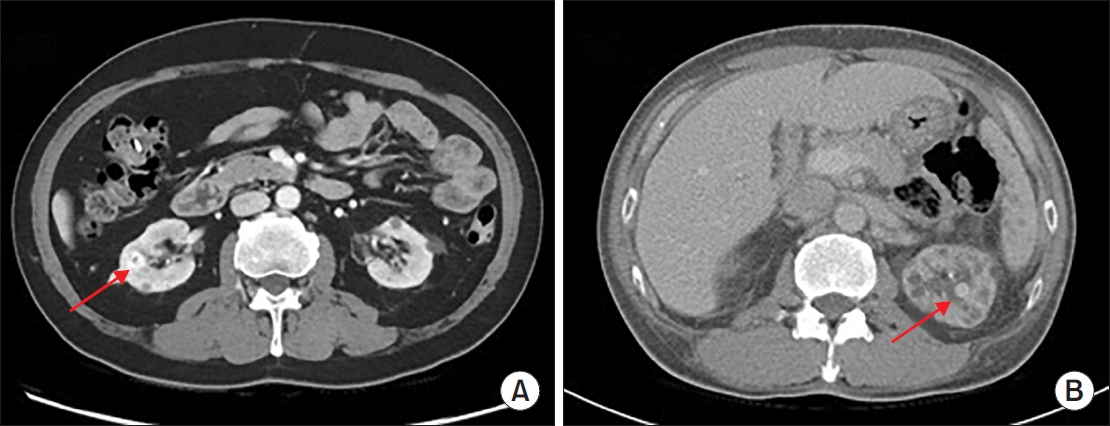
- Hemangiomas are rare, benign vascular neoplasms that are more common in patients with end-stage renal disease. Here, we describe 2 cases of hemangioma misdiagnosed as renal cell carcinoma before renal transplantation. The key finding in our case was the misdiagnosis of hemangiomas as renal cell carcinoma based on computed tomography and magnetic resonance imaging in patients with end-stage renal disease. Because living transplantation was planned for our patients, we performed rapid surgical resection of the heterogeneously enhancing renal masses to avoid delays in transplantation. Our case highlights the importance of rapid surgical resection of enhanced renal masses to confirm diagnosis, thereby avoiding delays in patients scheduled for renal transplantation.
-
Citations
Citations to this article as recorded by
- Editorial for UTI 2025 Vol. 20 No. 1 - Highlights of This Issue’s Papers and the UTI Editors’ Pick
Koo Han Yoo
Urogenital Tract Infection.2025; 20(1): 1. CrossRef
- Editorial for UTI 2025 Vol. 20 No. 1 - Highlights of This Issue’s Papers and the UTI Editors’ Pick
- 4,945 View
- 31 Download
- 1 Crossref
 First
First Prev
Prev


