



Search
- Page Path
- HOME > Search
Review Article
- Human Papillomavirus-Related Diseases in Urology: Diagnosis, Treatment, Prevention, and Clinical Considerations for Healthcare Providers
- Kyu Won Lee, Amit Mani Upadhyay, Sangrak Bae
- Urogenit Tract Infect 2026;21(2):56-73. Published online August 31, 2026
- DOI: https://doi.org/10.14777/uti.2652020.010
-
 Abstract
 PDF
PDF PubReader
 ePub
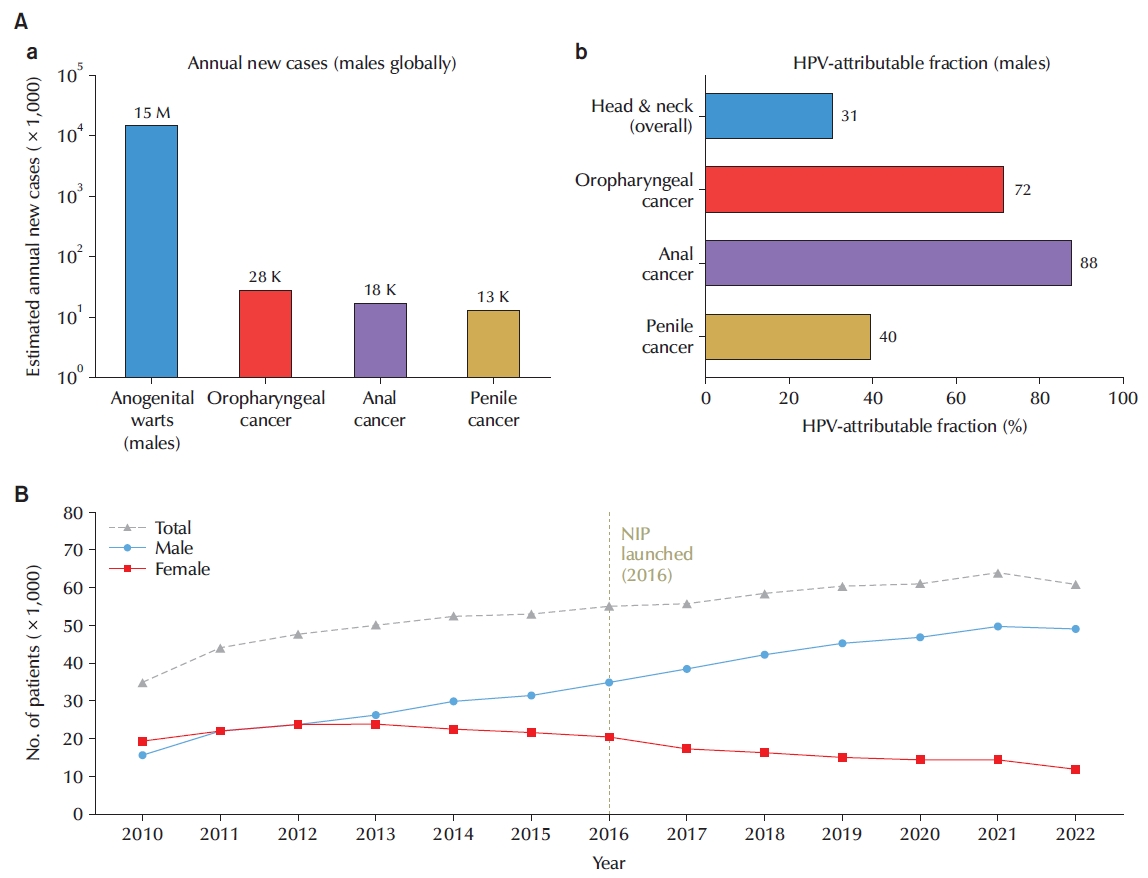
ePub - Human papillomavirus (HPV) has long been regarded as a gynecologic pathogen, yet its disease burden in men is substantial and rapidly increasing. In Korea, the prevalence of anogenital warts in men has tripled over the past decade, penile cancer continues to rise, and HPV-positive oropharyngeal cancer (OPC) incidence in men has already exceeded that of cervical cancer in comparable high-income countries. This review reframes HPV as an urgent urological, occupational, and public health concern. Drawing primarily on the 2023 Korean Sexually Transmitted Infection (STI) Guidelines and the 2021 U.S. Centers for Disease Control and Prevention STI Treatment Guidelines, supplemented by original primary literature retrieved from PubMed, we address: (1) the male-specific epidemiological shift; (2) nonsexual and occupational transmission routes, with particular emphasis on surgical smoke; (3) evidence-based infection control in urology practice; (4) clinical management of anogenital warts; (5) male HPV vaccination policy, international comparisons, and cost-effectiveness; and (6) future research priorities including OPC prevention, HPV and male infertility, and the need for urology-specific infection control guidelines. From 2026, Korea will include 12-year-old boys in its National Immunization Program—the first gender-neutral HPV vaccination policy in Korea. This review highlights the expanding and indispensable role of urologists in HPV management and emphasizes that infection control vigilance and gender-neutral vaccination strategies are essential to reduce the mounting societal burden of HPV-related diseases. This review provides a practical framework for urologists to integrate HPV prevention, infection control, and vaccination counseling into routine clinical practice.
- 1,221 View
- 52 Download

Editorial
- Male Human Papilloma Virus Infections: How to Prepare for Vaccination Strategies
- Jeonghyouk Choi, Koo Han Yoo
- Urogenit Tract Infect 2024;19(1):1-2. Published online April 30, 2024
- DOI: https://doi.org/10.14777/uti.2024.19.1.1
- 3,027 View
- 18 Download
Reviews
- Why Should You Care About Oral Gonorrhea and Oral Human Papillomavirus Infection?
- Jae Yong Jeong, Seok Cho, Hae Do Jung
- Urogenit Tract Infect 2023;18(1):20-23. Published online April 30, 2023
- DOI: https://doi.org/10.14777/uti.2023.18.1.20
-
Abstract
PDFPubReaderePub
- The incidence of sexually transmitted diseases is increasing with the open-sex culture and as people are having sex at a younger age. Consequently, oral gonorrhea and oral human papillomavirus infections, which are often asymptomatic, result in a high risk of transmission. Oral gonorrhea is symptomatic in less than 20% of patients confirmed by culture for Neisseria gonorrhoeae in both men and women. Even if symptoms develop and oral gonorrhea is diagnosed and treated, the cure rate is less than 90%. Hence, oral gonorrhea can lead to antibiotic resistance to gonorrhea. Oral human papillomavirus infections have received more attention because oral human papillomavirus infections play an important role in the development of oropharyngeal cancer. On the other hand, no test for diagnosing human papillomavirus in the oral cavity has been approved by the US Food and Drug Administration. This lack of test makes it difficult to detect oral human papillomavirus infection early, which can further increase the risk of transmission of human papillomavirus infections. Preventing human papillomavirus infections is very important because surgical resection is the only treatment. Vaccination against human papillomavirus-associated oropharyngeal cancers, including tonsil cancer and base of the tongue cancer, has been reported to be effective in reducing the prevalence of oral human papillomavirus infection in middle-aged adults. Human papillomavirus vaccination is essential for protecting against oral human papillomavirus infection.
- 22,763 View
- 53 Download
- What Are the Barriers to Human Papillomavirus Vaccination for Male in South Korea?
- Sangrak Bae, Sooyoun Kim
- Urogenit Tract Infect 2022;17(3):53-60. Published online December 31, 2022
- DOI: https://doi.org/10.14777/uti.2022.17.3.53
-
Abstract
PDFPubReaderePub
- The human papillomavirus (HPV) virus causes genital warts, a sexually transmitted disease, as well as cervical and vulvar cancer in females and penile cancer in males. In addition, it this virus causes various diseases, including head and neck cancer and anal cancer. Vaccines can prevent malignant tumors caused by the HPV virus, and various projects are being conducted to eradicate HPV worldwide. The national inoculation program is a representative project among them. In Korea, only females are vaccinated; males are not included in the national mandatory vaccination list. Various reasons preventing HPV vaccination for males include cost-effectiveness, fear and misperception of side effects after vaccination, problems with the effectiveness of vaccination, and lack of social awareness about the need for vaccination, including parents, and the lack of research on male HPV disease. As female’s right to health is emphasized, HPV disease, which has become more important in treatment, will never be cured if it is managed only for females. Because the disease is transmitted sexually, managing and controlling HPV in males is also essential. In that sense, males must also be included as nationally required vaccination targets.
- 10,659 View
- 23 Download
 First
First Prev
Prev


