


Search
- Page Path
- HOME > Search
Review Article
- Antibiotic Prophylaxis for Transrectal Prostate Biopsy
- Do Gyeong Lim, Seung Il Jung
- Urogenit Tract Infect 2026;21(2):47-55. Published online August 31, 2026
- DOI: https://doi.org/10.14777/uti.2652012.006
-
 Abstract
 PDF
PDF PubReader
 ePub
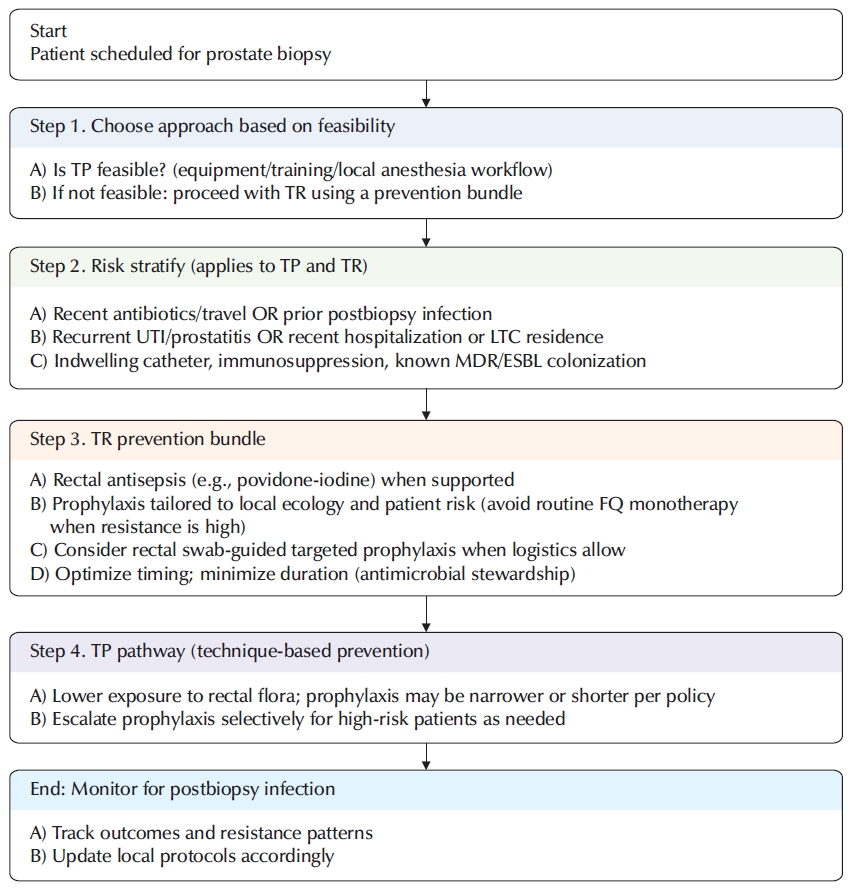
ePub - Transrectal prostate biopsy (TRPB) is widely used for the diagnosis of prostate cancer but carries a clinically meaningful risk of infectious complications due to inoculation and translocation of rectal flora into the urinary tract and bloodstream. Antibiotic prophylaxis remains central to preventing febrile urinary tract infection and sepsis; however, increasing antimicrobial resistance—particularly fluoroquinolone-resistant Enterobacterales—has reduced the reliability of conventional empirical regimens in many regions. In this narrative review, we searched PubMed/MEDLINE, Embase, and Scopus for relevant literature published through February 2026 and synthesized current guideline positions and selected clinical evidence on prophylactic regimens, resistance-adapted regimen selection, and adjunctive measures for TRPB. Cumulative evidence indicates that the efficacy of fluoroquinolone monotherapy has significantly declined in regions with high-resistance prevalence. Alternative or augmented strategies (e.g., cephalosporin- or fosfomycin-based approaches) may reduce infectious complications in selected settings, although their performance appears context-dependent and may be accompanied by shifts in pathogen distribution. Rectal swab-guided targeted prophylaxis can individualize antibiotic selection; however, its effectiveness varies across studies because of methodological heterogeneity and imperfect prediction of clinical outcomes. Technique-based prevention, most notably transperineal biopsy, may reduce infectious risk while decreasing reliance on broad-spectrum prophylaxis. Taken together, infection prevention after prostate biopsy should be individualized according to local susceptibility patterns and patient-level risk while integrating antimicrobial stewardship and selecting adjunctive or technique-based measures when feasible.
- 1,051 View
- 14 Download

Original Article
- Efficacy of D-Mannose in the Management of Urinary Tract Infections: From Acute Treatment to Long-term Prophylaxis — A Systematic Review and Meta-analysis
- Jae Yong Jeong, Young Joon Moon, Dong Hyuk Kang, Hae Do Jung, Lawrence Kim, Joo Yong Lee
- Urogenit Tract Infect 2026;21(2):111-124. Published online August 31, 2026
- DOI: https://doi.org/10.14777/uti.2652010.005
-
Abstract
PDF
 Supplementary MaterialPubReaderePub
 - Purpose
To evaluate the efficacy of D-mannose for preventing recurrent urinary tract infections (UTIs), including in kidney transplant recipients, and to clarify discrepancies between early openlabel and placebo-controlled trials. Materials and Methods: PubMed, Embase, CENTRAL (Cochrane Central Register of Controlled Trials), and Web of Science were searched from inception to February 2026. Randomized controlled trials (RCTs) comparing D-mannose with placebo, no treatment, antibiotics, or active controls were included. Risk of bias (RoB) was assessed using RoB 2, and certainty of evidence using GRADE (Grading of Recommendations, Assessment, Development, and Evaluations).
Results
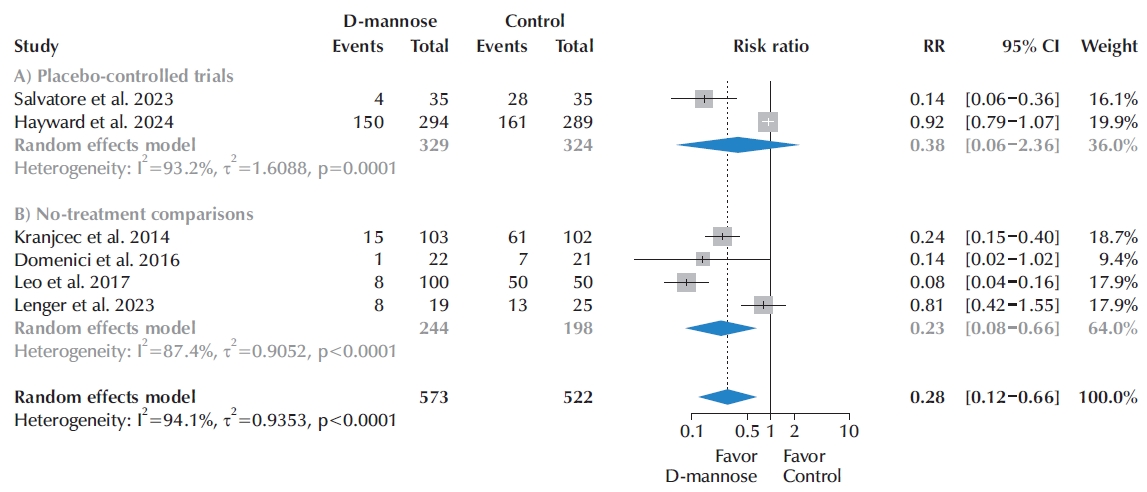
Eleven RCT reports involving 1,724 participants were included; 10 independent study populations involving 1,631 participants contributed to quantitative analyses. In placebo-controlled trials, D-mannose did not significantly reduce UTI recurrence or persistence versus placebo (risk ratio [RR], 0.38; 95% confidence interval [CI], 0.06–2.36). No-treatment comparisons showed reduced recurrence (RR, 0.23; 95% CI, 0.08–0.66), but were more vulnerable to expectation, performance, and detection biases. The exploratory combined estimate favored D-mannose (RR, 0.28; 95% CI, 0.12–0.66), but certainty was very low. Antibiotic comparisons were inconclusive (RR, 0.43; 95% CI, 0.18–1.05), whereas proanthocyanidins active-control comparisons favored D-mannose-containing regimens (RR, 0.57; 95% CI, 0.40–0.82), including data from kidney transplant recipients.
Conclusions
Current placebo-controlled evidence does not establish superiority of D-mannose over placebo. Apparent benefits were mainly driven by no-treatment comparisons with very low certainty. D-mannose remains biologically plausible but clinically uncertain; adequately powered, double-blind, placebo-controlled trials are needed before firm recommendations can be made.
- 1,630 View
- 18 Download
 First
First Prev
Prev


