-
Role of Presepsin as a Predictive Factor for Sepsis in Patients With Urinary Tract Infection Associated With Ureteral Calculi: A Retrospective Cohort Study
-
Jong Gyun Ha, Hee Chang Jung, Yeong Uk Kim
-
Urogenit Tract Infect 2026;21(2):89-95. Published online August 31, 2026
-
DOI: https://doi.org/10.14777/uti.2652014.007
-
-
 Abstract Abstract
 PDF PDF PubReader PubReader ePub ePub
- Purpose
Recently, multiple studies have reported presepsin as a useful inflammatory biomarker for early sepsis diagnosis in patients with urinary tract infections (UTIs). Nonetheless, few studies have evaluated the efficacy of presepsin in urosepsis associated with ureteral calculi. We retrospectively investigated the efficacy of presepsin for early urosepsis diagnosis associated with ureteral calculi.
Materials and Methods: Between May 2021 and July 2023, 64 patients with UTI associated with ureteral calculi were included. Sepsis was defined as a Sequential Organ Failure Assessment (SOFA) score increase of ≥2 points. Patients were divided into 2 groups, with (n=38) and without (n=26) sepsis, and we assessed clinical characteristics (age, sex, and past medical history), laboratory data, and stone characteristics. Additionally, we evaluated predictive factors for urosepsis associated with ureteral calculi and compared these factors with inflammatory biomarkers.
Results
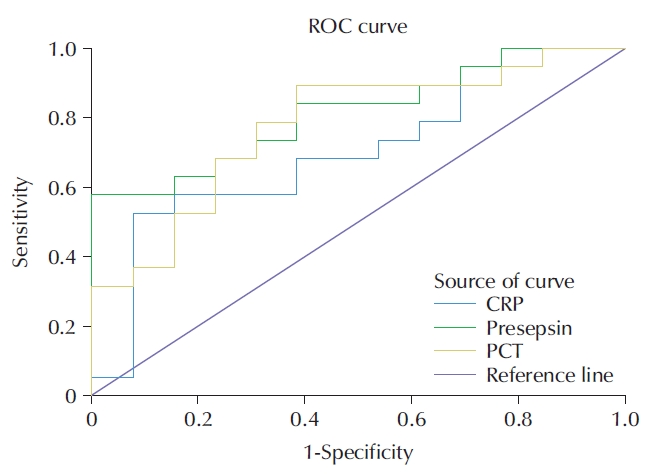
The proportion of females in the sepsis and nonsepsis groups was 89.5% (n=34) and 61.5% (n=16), respectively. In univariable analysis, low albumin level, low platelet count, and presepsin and procalcitonin (PCT) levels correlated with sepsis (p<0.05). In univariable logistic regression analysis, quick SOFA (odds ratio [OR], 2.071; p=0.033), C-reactive protein (CRP; OR, 1.08; p=0.01), PCT (OR, 1.025; p=0.008), and presepsin (OR, 1.354; p=0.001) were significantly associated with sepsis. In multivariate logistic regression analysis, presepsin (OR, 1.321; p=0.003) was significantly associated with sepsis. In receiver operating characteristic curve analysis of inflammatory markers, the areas under the curve for CRP, PCT, and presepsin were 0.704, 0.777, and 0.814, respectively.
Conclusions
Elevated presepsin levels may help predict sepsis occurrence in patients with UTI associated with ureteral calculi, thereby supporting timely and appropriate intervention.
-
Renal Venous Perforation during Reinsertion of a Percutaneous Nephrostomy Catheter
-
hil Hyun Song, Young Hwii Ko, Bong Gi Ok, Yeong Uk Kim, Kwon Soo Lee, Dae Hyeon Kwon, Hyun Tae Kim, Sin-Youl Park, Hee Chang Jung
-
Korean J Urogenit Tract Infect Inflamm 2014;9(1):56-59. Published online April 30, 2014
-
-
-
Abstract
PDF
- While the sustainment of percutaneous nephrostomy with regular change in chronic un-operable cases is widely performed for relief of urinary obstructions, performance of the blind procedure without fluoroscopic monitoring could result in clinical disaster. We report on a case of direct renal vein injury by mis-guidance of a nephrostomy catheter, which was successfully managed conservatively by serial venography monitoring combined with intensive conservative treatment. To the best of our knowledge, this is the first report on management of a renal vein injury during the percutaneous nephrostomy.
-
Memokath Stent Insertion for the Management of Bilateral Ureteral Obstructions from Retroperitoneal Fibrosis
-
Phil Hyun Song, Yoon Seob Ji, Jong Min Kim, Hee Chang Jung
-
Korean J Urogenit Tract Infect Inflamm 2012;7(1):63-67. Published online April 30, 2012
-
-
-
Abstract
PDF
- Retroperitoneal fibrosis is a rare disease characterized by the presence of a retroperitoneal tissue, consisting of chronic inflammation and marked fibrosis, which often causes ureteral obstruction. Surgical approach is necessary to preserve the renal function, and this is achieved by ureteral stent. The Memokath stent is a new thermo-expandable shape-memory metallic stent. Herein, we report our recent experience of a patient with retroperitoneal fibrosis, which involves bilateral ureter, who underwent successful bilateral Memokath stent insertion.
|